
What you mean, “Walk the Earth”?
You know, like Caine in Kung Fu. Walk from place to place, meet people, get into adventures.
– Pulp Fiction
You may find yourself, in another part of the world.
And you may ask yourself: How Did I Get Here?
– Talking Heads (Once in a Lifetime)
Total Distance Pedaled: 558 km
Number of Reindeer Spotted: All of them. I’ve seen the entire fleet.
Ladies & Gentlemen, Serfs, Scallywags and Flea Bitten Tramps:
Welcome back!
It’s been a couple of years.
Well don’t just stand there! Close the door and come on in! Pull up a chair. I’ll put the kettle on and we’ll get right down to business.
I’m writing to you from Tromsø, Norway.
It’s this whole other country.
I arrived in Norway through the miracle of human flight. I crawled into a giant aluminum tube in Calgary. Lucky for me, inside that tube they were serving cocktails! So after a gin & soda, a beer, and about 14 hours, I was deposited in Oslo. From Oslo I took another flight to Alta, and then a bus to the Nordkapp. And this is where our adventure begins.
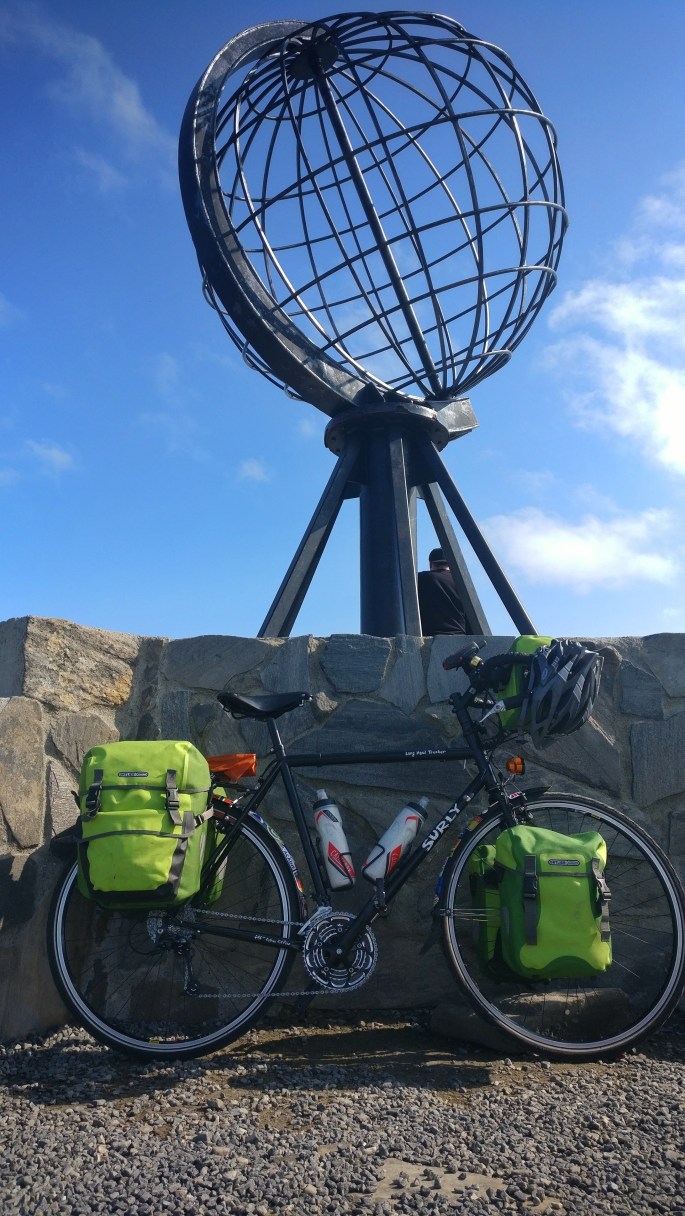
The Nordkapp (North Cape) is the most northern point in Europe that you can reach by road. To go further north, you’d have to bust out the canoe and travel to the Svalbard Islands. And since the Russian Northern Fleet is based just a few hundred kilometers south east at Murmansk, it’s not the kinda place that lends itself to recreational boating. Last thing I need is Sean Connery chasing after me in a nuclear submarine, trying to defect to America.
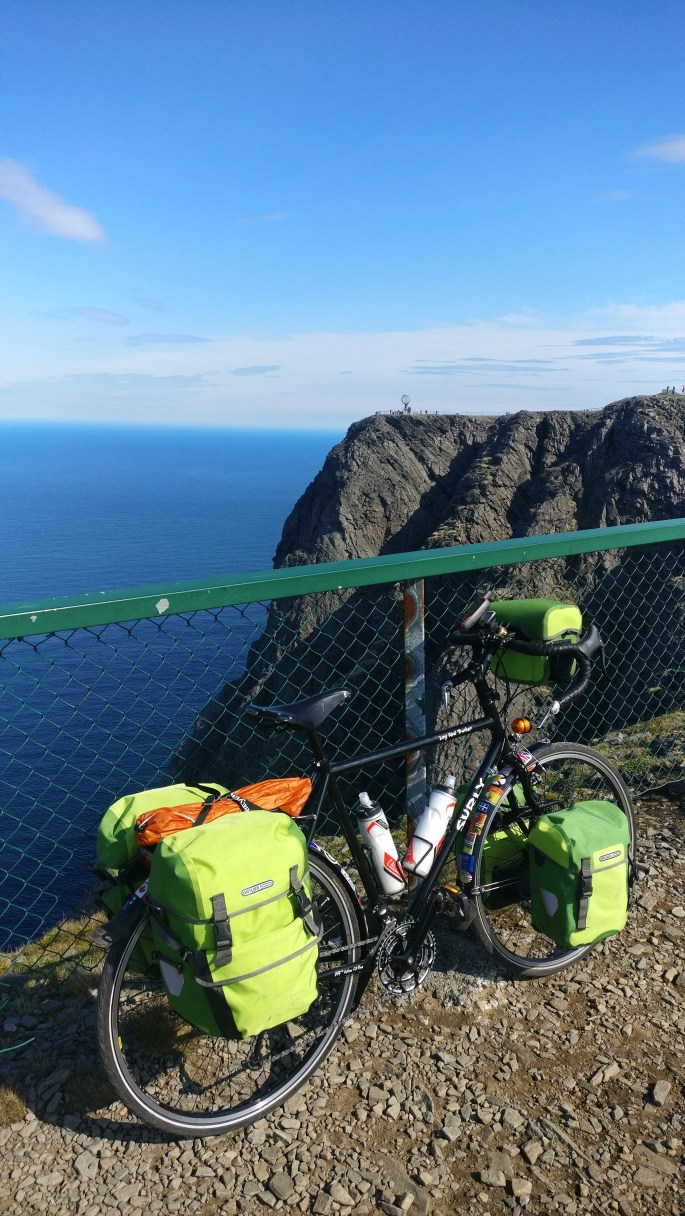
At 71 deg north, the Nordkapp is well inside the Arctic Circle. It was a 1000′ drop to the Arctic Ocean, so there wasn’t going to be any ceremonial “dipping of the bicycle wheels”. I’d never seen the Arctic Ocean before, and I was really lucky as this particular patch of real estate spends about 330 days a year shrouded in fog. I had a beautiful blue sky and light winds.
The journey south was mostly downhill to the town of Honningsvåg. Honningsvåg and the Nordkapp are located on an island connected to the mainland by a tunnel. An underwater tunnel, herein referred to as the Big Scary Tunnel of Doom! (BSTD)
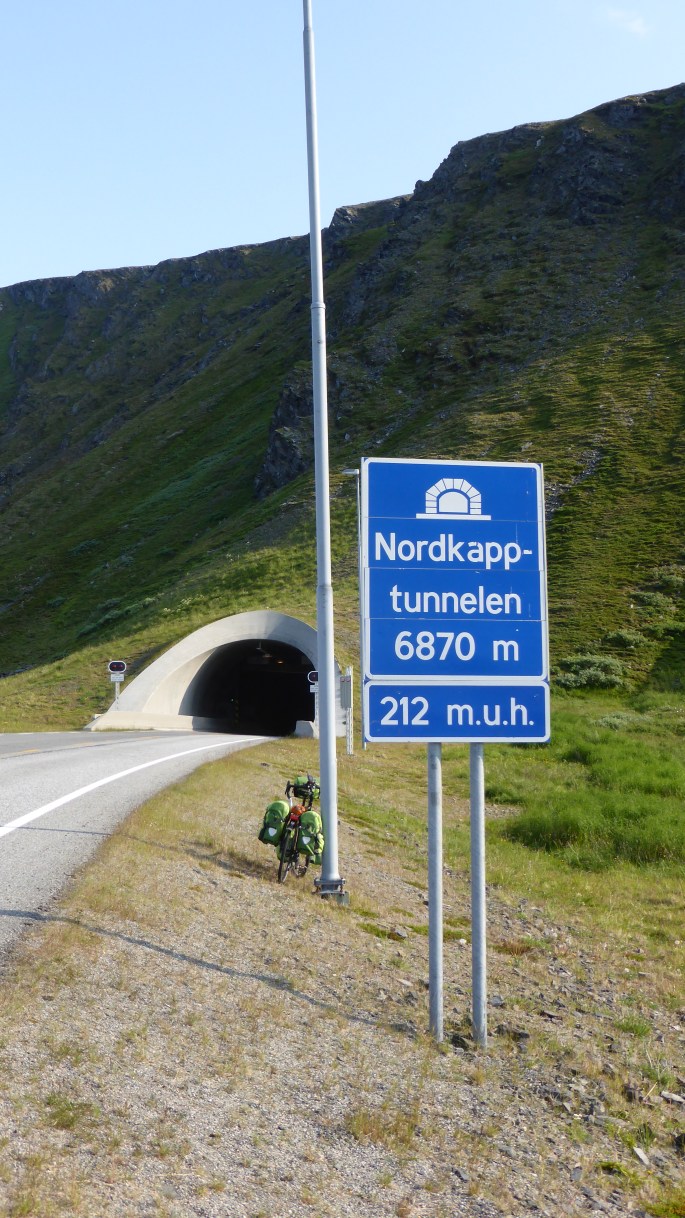
The BSTD is about 7km long and 200 meters beneath the water. To illustrate the situation, I’ve prepared this lovely visual aid.

Inside the tunnel it’s dark, damp, and only a few degrees above freezing.

It’s also incredibly loud. The Nordkapp appears to be a magnet for every motorcycle rider on the continent, and they all pass through this tunnel. Harley Davidson’s are annoying enough in the open air, but put one in a concrete tube under the ocean and it sounds like the 4 horsemen of the apocalypse are galloping up behind you. The most insidious thing however about the BSTD, is the grade of the roadway. Like the drawing above, the road is laid out in a U shape, with hills on either end and only a brief flat spot in the middle. The hills are graded at about 10%. This is steep for a bicycle and means that for the last 3.5km, you’re grinding your way uphill, panting and sweating, like a fat man on a treadmill.
Once I’d cleared the BSTD, I began to look for a place to spend the night. I’d logged 80km, which is a respectable number for a half-day as I didn’t leave the Nordkapp ’till 1:30 in the afternoon. Norway subscribes to the Scandinavian philosophy that the land belongs to the people, and it’s written into their laws that a traveller can spend up to 2 nights, more or less wherever you decide to pitch your tent. There are a few more conditions attached to the “Right to Roam” law to guard against gypsie camps and such, but the spirit is simple: Respect the land – Sleep where you want – Don’t be a dick.
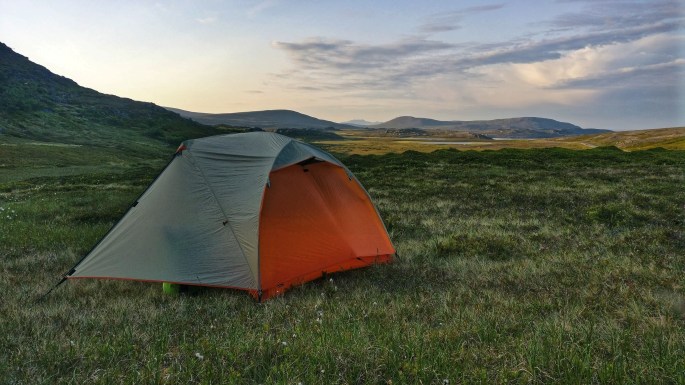
Babies don’t sleep this well.
Preparing for this trip, I decided to try something new. I had just finished reading Adam Savage’s book “Every Tool is a Hammer”. In it, Adam stresses the importance of making lists; he is an obsessive list maker. Normally before heading out on an adventure, I might make a basic list, but the bulk of the information is in my head and I just assemble the pieces and go. This time I listed everything, right down to the most minute detail.

The benefits of this exercise is that I didn’t forget anything. The curse was seeing all that stuff – page after page after page – laid out in neat columns, freaked me out, and I began cutting items in an effort to reduce the size of the list. At this point it’s worth mentioning that this isn’t my first bike tour, and in hindsight, if I’d considered it important enough to put it on the list in the first place, I should have kept it there. The end result was I found myself in Arctic Norway, wild camping on the side of the road, with no way to purify water other than by boiling, ’cause I’d decided to leave my water filter AND tablets at home.
I’m not a smart man.
– Forrest Gump
This forced me to conserve my drinking water, which quickly lead to dehydration, muscle cramps and urine the colour of iced tea.
But there was no shortage of water around.
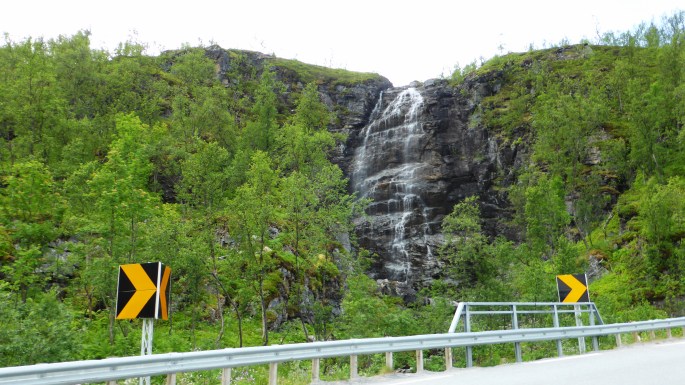
Most of it likely as pure as water can get. However, without some form of assurance against sickness, I was hesitant to drink. The last thing I wanted was to spend the next 2 weeks in a hospital bed, sick with intestinal bugs, suffering daily sponge baths from absurdly hot, blonde, Norwegian nurses. I did make one exception, however:
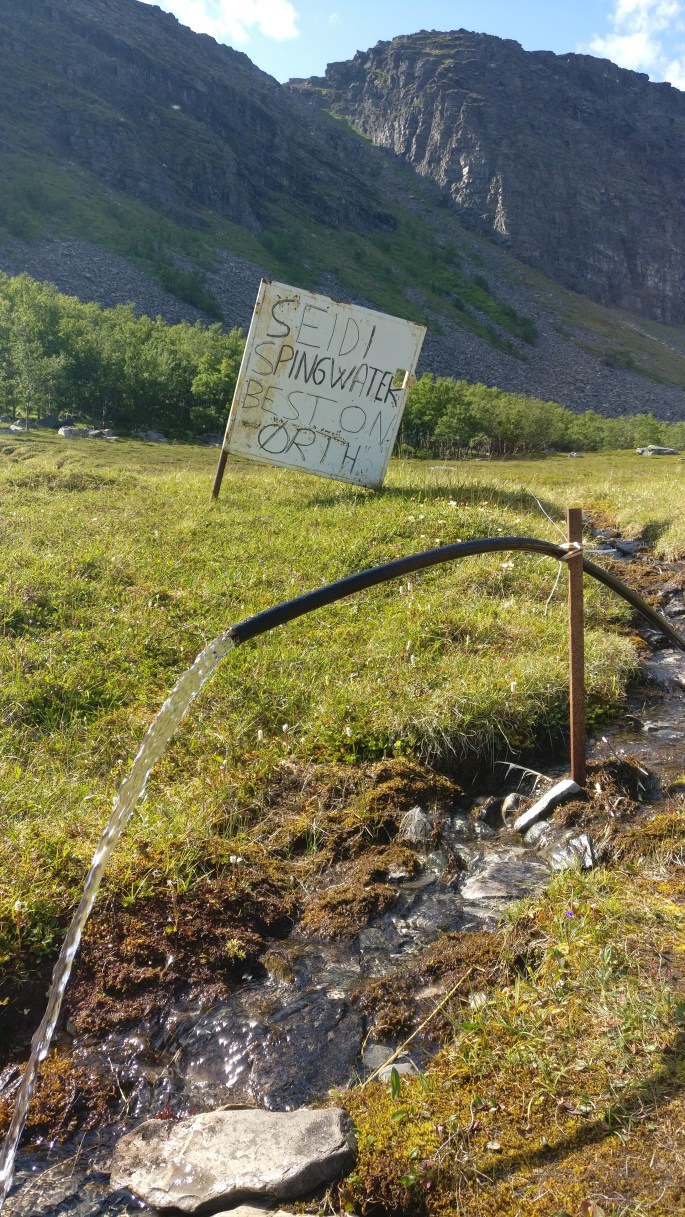
When someone goes to the trouble of making a sign, advertising the best water on ORTH, you drink.
That was some high quality H20. I drank long and deep.
I rode the 250km to Alta and visited the shops. I wasn’t able to find a filter or purification tablets, and while I could have bought a bottle of bleach and used that to clean the water, I elected to buy 2 more water bottle cages and jury-rigged then to my front forks.

This gave me an additional 2 litres of water and was certainly worth the 2Kg weight penalty.
Thusly armed with my new water bottles and a pair of padded shorts to cushion the saddle sores I’d developed due to a poor choice in boxer shorts, I headed out from Alta, bound for the city of Tromsø.
The landscape changed from tablelands and scrub brush to fjords and mountains with a distinct alpine profile. It was beautiful.

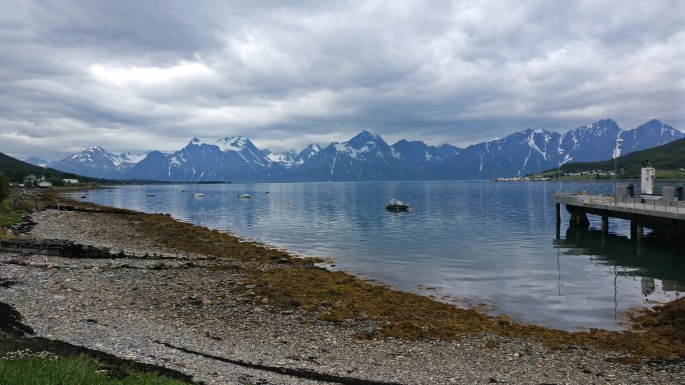
The Norwegians are fabulous tunnel builders (as previously noted), and on many occasions I was able to ride straight through the mountain rather than having to climb over the top. This wasn’t however, always the case. Some tunnels are closed to cyclists, meaning you have to take an alternate road over or around whatever obstacle the cars and trucks have the privilege of driving through. Sometimes though, there is no tunnel and everyone has to haul-ass over the top, which was the case with Kvænangsfjellet.
It was a 400 meter vertical gain from sea level to the pass, the 2nd big climb I’d made that day.
“400 meters”, I thought. That’s nothing. Why, that’s only 1300′ (in American Freedom Units).
I was wrong. That climb hurt.
Now, before you get too judgy in your armchair, keep in mind that not all bicycles are created alike. The sub 20 pound carbon racer you ride on the weekend is not the same as a fully loaded touring machine. If bicycles were furniture, a touring bike would be that pull-out-couch your Aunt has in her basement; heavy, awkward, and built like a tank.
In addition to this blog, I’m also keeping a journal where I jot down things as they come to mind. Here’s my entry from that day:
23 July 2019
The steady whir of the the chain over the sprockets. The cadence of my breathing – you could set your watch to it. Sweat drips from beneath my helmet. My mouth hangs open half an inch as I suck for oxygen. Glancing at the speedometer, I’m crawling uphill at an infuriatingly slow 7.6 km/h. My forearms are bronzed from the sun and coated in an oily sheen of sunscreen, sweat and bug repellent.
“This fuckin’ sucks!”, I hear my inner voice say.
Desperate for distraction, I start studying the cracks in the pavement. Pondering the battle scars on the steel guard rails that line the road.
40 minutes of climbing go by and I look up as the road continues its switchbacks towards the mountain pass above.
“Not there yet”.
It’s amazing that your body can do things your brain has no interest in getting involved with.

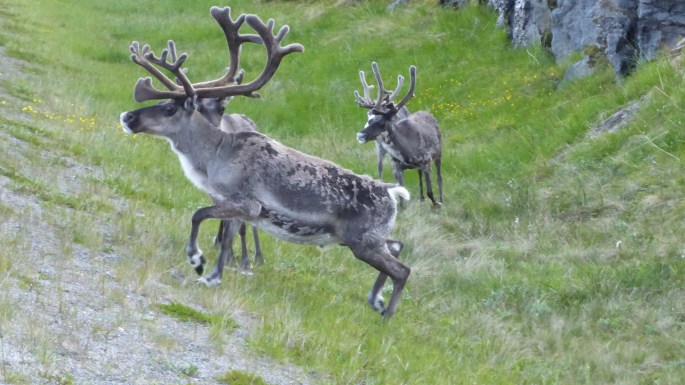
One cool thing about slogging my way over that mountain range at a snails pace was I got to see things you wouldn’t notice from a car. Like this herd of reindeer hanging out on the mountainside on a big patch of snow.


Reindeer are everywhere in this part of the world, and you have to stay switched on so you don’t plow into one with your car (or bicycle).

Now that I’m in Tromsø, I need to decide where to go next. My initial plan was to head directly south towards Narvik, but now that I’m here and have been chatting with the locals, I think I’ll keep going west. I can head west and with the help of a few ferry boats, take a swing through the Lofoten Islands before rejoining the mainland on my way towards Denmark. Lofoten is supposed to be pretty special and it’d be a shame not to check it out while I’m in the neighborhood. Wherever I end up, I’m sure it’s going to be interesting.
So until next time my friends, I bid you peace, love and soul!
Steve
 2 Canucks in a Tent